Continuous glucose monitoring (CGM) has transformed type 1 diabetes management by replacing occasional finger-prick snapshots with a continuous, real-time picture of glucose levels. Instead of a handful of readings a day, a CGM provides a reading every one to five minutes, along with trend arrows, customisable alarms, and detailed reports. The result, supported by both clinical trials and real-world UK data, is lower HbA1c, more time in range, and fewer dangerous highs and lows.
This guide explains exactly how CGM technology improves outcomes for people with type 1 diabetes, from the data it provides to the daily decisions it supports. If you are new to glucose monitoring, our overview of blood glucose testing options is a useful starting point.
How CGM helps in type 1 diabetes
- Lowers HbA1c by roughly 0.5% in real-world studies of sustained use.
- Increases time in range, with every 5% improvement considered clinically meaningful.
- Reduces hypoglycaemia through predictive and real-time low alerts.
- Enables proactive decisions using trend arrows that show where glucose is heading.
- Supports automated insulin delivery when paired with a compatible pump in a hybrid closed-loop system.
From snapshots to a full picture
A traditional finger-prick test tells you your glucose at a single moment, but nothing about where it was heading. Type 1 diabetes involves constant glucose fluctuation, so a handful of readings a day inevitably misses much of what happens between them, including overnight lows and post-meal spikes.
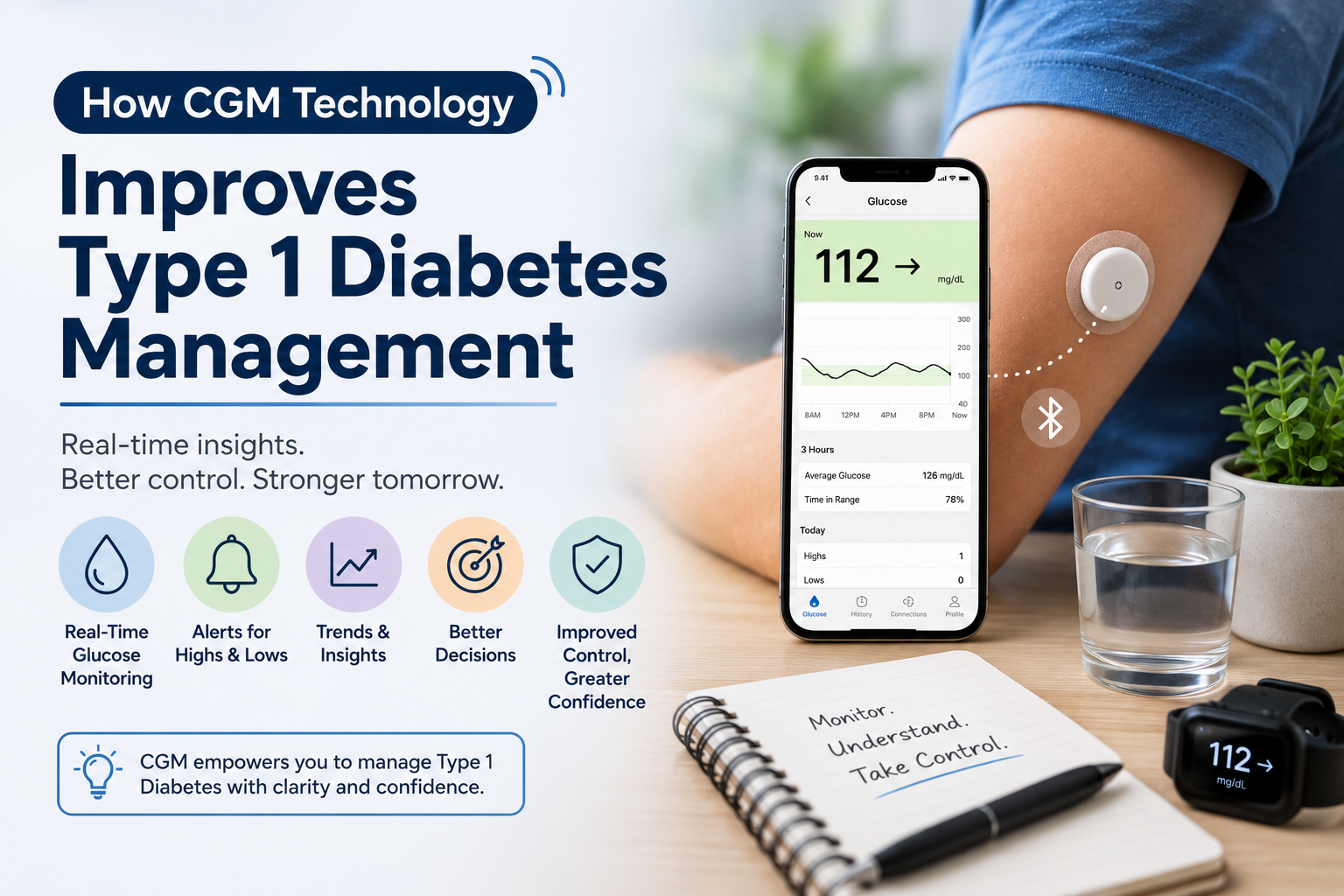
A CGM measures glucose in the interstitial fluid just beneath the skin, sending readings continuously to a phone or receiver. This produces hundreds of data points a day and reveals patterns that finger-pricks simply cannot capture. Finger-prick testing still has a role for confirmation, and keeping a backup meter and test strips on hand remains sensible, but the CGM becomes the primary source of day-to-day information.
The shift to time in range
For decades, HbA1c, a measure of average glucose over about three months, was the main marker of control. It remains important, but it is only an average and hides the highs and lows that matter day to day. CGM introduced a more informative metric: time in range (TIR), the percentage of the day glucose stays within the target range of 3.9 to 10.0 mmol/L (70 to 180 mg/dL).
The international consensus recommends that most people with type 1 diabetes aim for more than 70% time in range, with less than 4% of the day spent low. Crucially, every 5% increase in time in range is considered clinically meaningful, which gives people a clear, motivating target they can influence day by day rather than waiting months for a single HbA1c result.
How CGM improves daily decisions
Trend arrows enable proactive action
Perhaps the single most useful feature is the trend arrow, which shows not just the current glucose but the direction and speed of change. A reading of 6 mmol/L with a steady arrow calls for no action, but the same reading with a sharp downward arrow signals an approaching low. This lets people act before a problem develops, rather than reacting after it has already happened.
Alarms reduce dangerous highs and lows
Customisable high and low alarms, and predictive alerts that warn of a low before it arrives, are especially valuable for anyone with impaired hypoglycaemia awareness or who experiences overnight lows. Clinical studies consistently show that CGM use reduces the time spent in hypoglycaemia, one of the most feared complications of type 1 diabetes.
Better insulin dosing and lifestyle insight
Seeing how specific meals, exercise, stress, and insulin doses affect glucose in real time helps people fine-tune their management. Over time, this pattern recognition supports smarter carbohydrate counting, better timing of insulin, and more confident adjustments around activity.
What the evidence shows
The clinical case for CGM in type 1 diabetes is strong and consistent across randomised trials and real-world data:
- HbA1c reduction: a large UK study of 789 adults with type 1 diabetes found significant HbA1c reductions with both flash and real-time CGM, and propensity-matched data show sustained use lowering HbA1c by around 0.5%.
- More time in range: trials show CGM increases daily time in range and reduces glucose variability compared with finger-prick monitoring.
- Less hypoglycaemia: CGM significantly reduces time spent below range, improving safety without sacrificing overall control.
- Quality of life: studies report reduced diabetes-related distress and higher treatment satisfaction, particularly in young people.
CGM as the foundation of automated insulin delivery
CGM does more than inform manual decisions. When paired with a compatible insulin pump, it becomes the sensing engine of a hybrid closed-loop, or automated insulin delivery, system. The CGM continuously feeds glucose data to an algorithm that automatically adjusts background insulin, nudging levels up or down without the user having to intervene for every change.
Real-world studies of these systems show substantial gains in time in range, often lifting people well above the 70% target while reducing lows. Several modern CGM sensors are approved to work with compatible pumps, making this technology increasingly accessible. Some devices, such as the FreeStyle Libre 3 Plus, are designed to link into these systems.
Getting started with CGM
In the UK, everyone with type 1 diabetes should be offered a CGM on the NHS under NICE guidance, though the specific device depends on local policy and clinical need. Widely prescribed options include the FreeStyle Libre 2 Plus and Dexcom ONE+, with higher-specification devices such as the FreeStyle Libre 3 and Dexcom G7 available for specific needs. If you buy privately, sensors are available from registered pharmacies, and our guide to affordable blood sugar testing in the UK explains how to keep costs manageable.
The bottom line
CGM technology improves type 1 diabetes management by turning glucose control from a series of blind snapshots into a continuous, actionable picture. It lowers HbA1c, increases time in range, reduces hypoglycaemia, and underpins the automated insulin delivery systems that represent the future of diabetes care. You can explore CGM sensors and diabetes monitoring supplies through the Diabetes Pharmacy online shop, and if finger-prick testing remains part of your routine, meters that do not need test strips can make confirmation checks simpler.
Frequently Asked Questions
- Does a CGM improve HbA1c in type 1 diabetes?
Yes. Both clinical trials and real-world studies show that CGM use lowers HbA1c, with sustained use associated with a reduction of around 0.5% on average. The benefit tends to be greatest when the CGM is worn consistently. - What is time in range, and why does it matter?
Time in range is the percentage of the day your glucose stays within the target range of 3.9 to 10.0 mmol/L. Most people with type 1 diabetes aim for more than 70%. It matters because it reflects day-to-day control that HbA1c, being an average, can hide, and every 5% improvement is clinically meaningful. - Can a CGM prevent hypoglycaemia?
A CGM cannot prevent lows on its own, but its real-time and predictive low alarms give you warning so you can act early. Studies show CGM use reduces the time spent in hypoglycaemia, which is particularly valuable for people with impaired hypoglycaemia awareness. - Do I still need to do finger-prick tests with a CGM?
Much less often. Modern CGMs are factory calibrated and do not need routine finger-prick calibration, but you should still confirm with a meter and test strips when a reading does not match your symptoms or glucose is changing rapidly. - Can a CGM work with an insulin pump?
Yes. When paired with a compatible pump, a CGM forms a hybrid closed-loop system that automatically adjusts background insulin based on live glucose data. These systems have been shown to significantly increase time in range. Always check that your specific pump and sensor are approved to work together.