
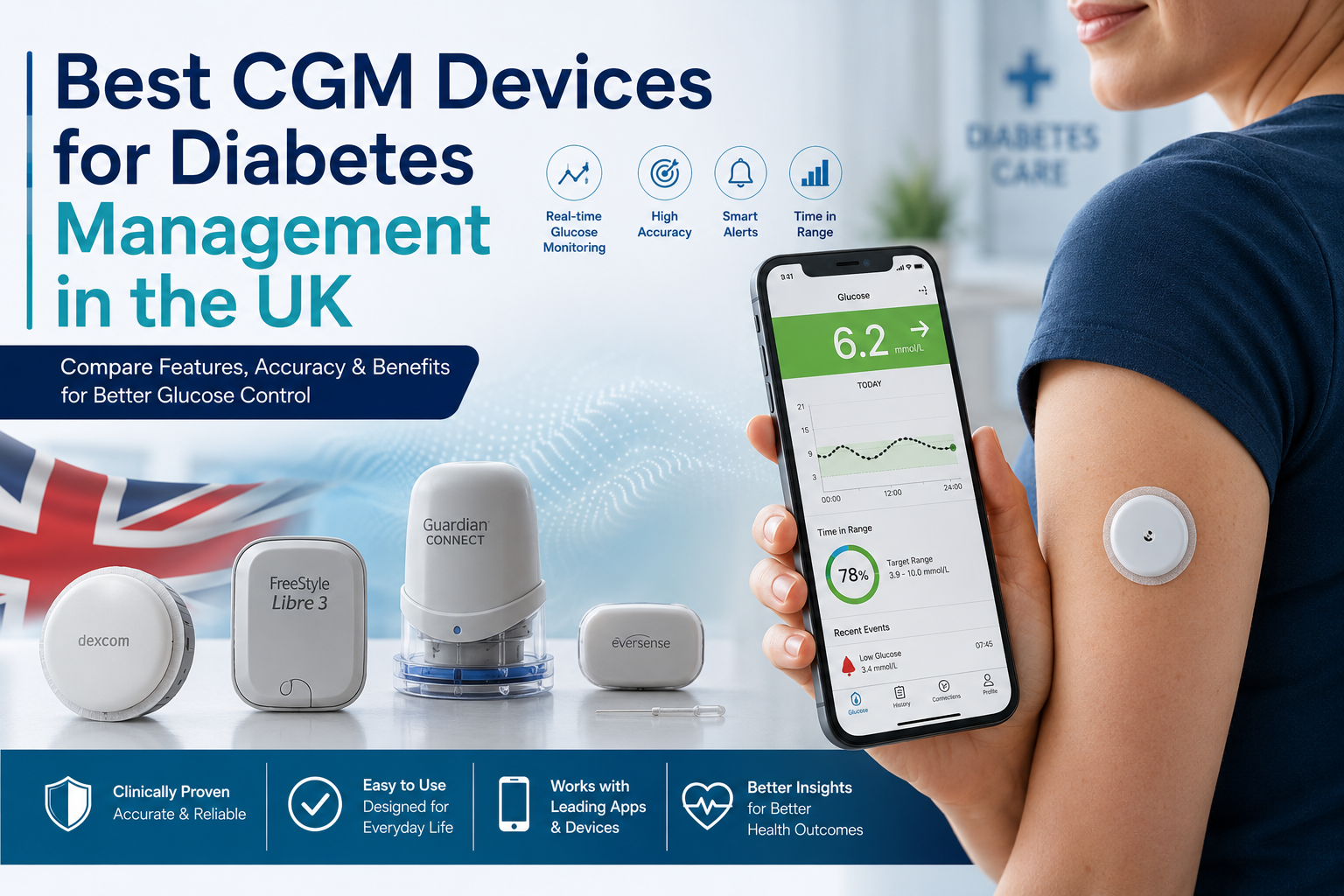
A continuous glucose monitor (CGM) is one of the most useful tools available for managing diabetes, replacing routine finger-prick checks with a steady stream of real-time glucose data. In the UK, the best CGM for you depends on your diabetes type, whether you use insulin, whether you want a device that connects to an insulin pump, and how you access it. The leading options are the FreeStyle Libre family (Libre 2 Plus and Libre 3 Plus) and the Dexcom family (Dexcom ONE+, G6 and G7), with newer arrivals such as the implantable Eversense 365 expanding the choice further.
This guide explains the best CGM devices by use case, how they compare, and how NHS access works, so you can have an informed conversation with your diabetes team. If you are new to glucose monitoring, our overview of blood glucose testing options is a helpful starting point.
Quick picks
- Best all-rounder for accuracy and alerts: Dexcom G7
- Best for sensor wear and value: FreeStyle Libre 3 Plus
- Best widely available NHS starter options: FreeStyle Libre 2 Plus and Dexcom ONE+
- Best for insulin pump users: Dexcom G7, for its broad pump integration
- Best for long-term, low-maintenance wear: Eversense 365, an implantable sensor
CGM devices compared
The table below summarises the main CGM systems available in the UK. Figures reflect manufacturer data and can change, so always confirm current specifications and availability with your provider.
Device | Wear time | MARD | Alerts | Best for |
FreeStyle Libre 2 Plus | 15 days | ~9% | Optional high/low alarms | Widely available NHS starter option |
FreeStyle Libre 3 Plus | 15 days | ~8% | Optional real-time alarms | Wear time, value, discreet monitoring |
Dexcom ONE+ | 10 days | ~9% | Customisable, repeat low alerts | Simple, lower-cost NHS starter option |
Dexcom G7 | 10 days (+grace) | ~8.2% | Customisable plus predictive lows | Accuracy, alerts, pump integration |
Eversense 365 | Up to 365 days | ~9% | On-body vibration alerts | Long-term, low-maintenance wear |
The best CGM devices in detail
One of the biggest concerns during summer is dehydration.
When the body loses fluids through sweating, glucose becomes more concentrated in the bloodstream. This can contribute to higher blood sugar readings.
Signs of dehydration include:
- Dry mouth
- Excessive thirst
- Fatigue
- Headaches
- Dark urine
Drinking water regularly throughout the day is especially important during hot weather.
At-a-glance comparison
The table below summarises how the main options compare. “Evidence strength” reflects the consistency and quality of human trials, not the size of the effect.
Supplement | Evidence | Typical studied dose | Key cautions |
Berberine | Strongest | 900 to 1,500 mg/day, split | GI upset; many drug interactions; avoid in pregnancy |
Alpha-lipoic acid | Moderate | 300 to 600 mg/day | Watch for lows alongside medication |
Magnesium | Moderate* | 250 to 350 mg/day | Benefit mainly if deficient; caution in kidney disease |
Cinnamon | Mixed | 1 to 6 g/day | Cassia is high in coumarin; keep doses moderate |
Chromium | Weak | 200 to 1,000 mcg/day | Interacts with thyroid medication |
*Strongest when correcting a genuine magnesium deficiency.
The best CGM devices in detail
FreeStyle Libre 3 Plus: best for wear time and value
The FreeStyle Libre 3 Plus is Abbott’s flagship sensor and one of the smallest CGMs available, roughly the size of two stacked pennies. It sends a glucose reading to your phone every minute, lasts up to 15 days, and offers optional real-time alarms. Its long wear time and competitive price make it a strong value choice, and it can link with several compatible insulin pumps for a hybrid closed-loop setup. The earlier FreeStyle Libre 3 remains widely used and offers the same core experience.
Dexcom G7: best all-rounder for accuracy and alerts
The Dexcom G7 pairs excellent accuracy (around 8.2 percent MARD) with a fast 30-minute warm-up, customisable alerts, and predictive low-glucose alerts that warn you before you go low. It lasts 10 days with a 12-hour grace period, tolerates being submerged in water for longer than most rivals, and integrates more widely with insulin pumps and automated insulin delivery systems. It is often the best pick for intensive insulin management or anyone with impaired hypoglycaemia awareness.
FreeStyle Libre 2 Plus and Dexcom ONE+: best NHS starter options
These two lower-cost formulary devices are the most widely prescribed CGMs on the NHS, and they meet the needs of most people who qualify. The FreeStyle Libre 2 Plus offers 15-day wear, optional alarms, and data sharing. The Dexcom ONE+ offers 10-day wear, a 30-minute warm-up, repeat low-glucose alerts, and data sharing with up to 10 followers. Both are excellent, dependable entry points to continuous glucose monitoring.
Eversense 365: best for long-term, low-maintenance wear
The Eversense 365 is an implantable CGM whose sensor is placed under the skin of the upper arm by a healthcare professional and lasts up to a year, with a removable transmitter worn on top. It removes the routine of changing sensors every couple of weeks, though it requires a small insertion and removal procedure. Availability in the UK is more limited than the patch-based systems, so it is worth asking your specialist team whether it is an option for you.
How to choose the right CGM
There is no single best CGM for everyone. The right choice comes down to a few practical questions:
- Do you use insulin, especially with a pump? If so, prioritise pump compatibility. The Dexcom G7 has the broadest integration.
- Do you need strong hypo protection? Predictive low alerts, as on the Dexcom G7, give you warning before a low.
- Is cost or wear time your priority? The FreeStyle Libre 3 Plus offers long wear and good value.
- Do you prefer minimal fuss? A widely available NHS option such as the Libre 2 Plus or Dexcom ONE+ may be all you need.
Whichever you choose, it is sensible to keep a backup meter and a supply of test strips for the times a CGM reading does not match how you feel or glucose is changing quickly.
Getting a CGM on the NHS
NHS eligibility is guided by NICE and your local Integrated Care Board. Broadly, everyone with type 1 diabetes should be offered a CGM, and people with type 2 diabetes on insulin may also qualify. Lower-cost devices such as the FreeStyle Libre 2 Plus and Dexcom ONE+ are the usual starting point, while higher-cost devices such as the FreeStyle Libre 3 and Dexcom G7 are reserved for specific clinical needs and are often initiated by specialist teams. Note that Dexcom is phasing out the older G6 in favour of the G7. If you do not qualify for NHS funding, sensors can be bought privately from registered pharmacies.
Conclusion
The best CGM is the one that fits your diabetes type, your treatment, and your daily life. The Dexcom G7 is the strongest all-rounder for accuracy, alerts, and pump integration, while the FreeStyle Libre 3 Plus leads on wear time and value, and the Libre 2 Plus and Dexcom ONE+ are dependable, widely available starting points. You can explore CGM sensors and diabetes monitoring supplies through the Diabetes Pharmacy online shop, and if finger-prick testing is still part of your routine, meters that do not need test strips can make regular checks simpler to sustain.
FAQs
- What is the most accurate CGM?
The Dexcom G7 and FreeStyle Libre 3 Plus are among the most accurate CGMs available, both with a MARD of around 8 percent. Accuracy is very close between the leading devices, and all are clinically reliable for everyday diabetes decisions when used as directed. - Which CGM lasts the longest?
Among patch sensors, the FreeStyle Libre 2 Plus and Libre 3 Plus last up to 15 days, compared with 10 days for Dexcom sensors. The implantable Eversense 365 lasts far longer, up to a full year, but requires a clinician to insert and remove it. - Can I get a CGM if I have type 2 diabetes?
Possibly. On the NHS, CGM is generally funded for type 2 diabetes when you are on insulin, though criteria vary locally. If you do not qualify, you can still buy a CGM privately, which some people with type 2 diabetes or prediabetes use to understand how food and activity affect their glucose. - Do CGMs replace finger-prick testing completely?
Mostly, but not entirely. Modern CGMs are factory calibrated and do not need routine finger-prick calibration, but you should still confirm with a meter and test strips when a reading does not match your symptoms or glucose is changing rapidly. - Which CGM works with an insulin pump?
Several do, but compatibility is specific. The Dexcom G7 has the broadest integration with pumps and automated insulin delivery systems, and some FreeStyle Libre sensors also connect with compatible pumps. Always check that your particular pump and sensor are approved to work together.